Ottawa’s Kìwekì Point Revitalized, Reimagining History and Space
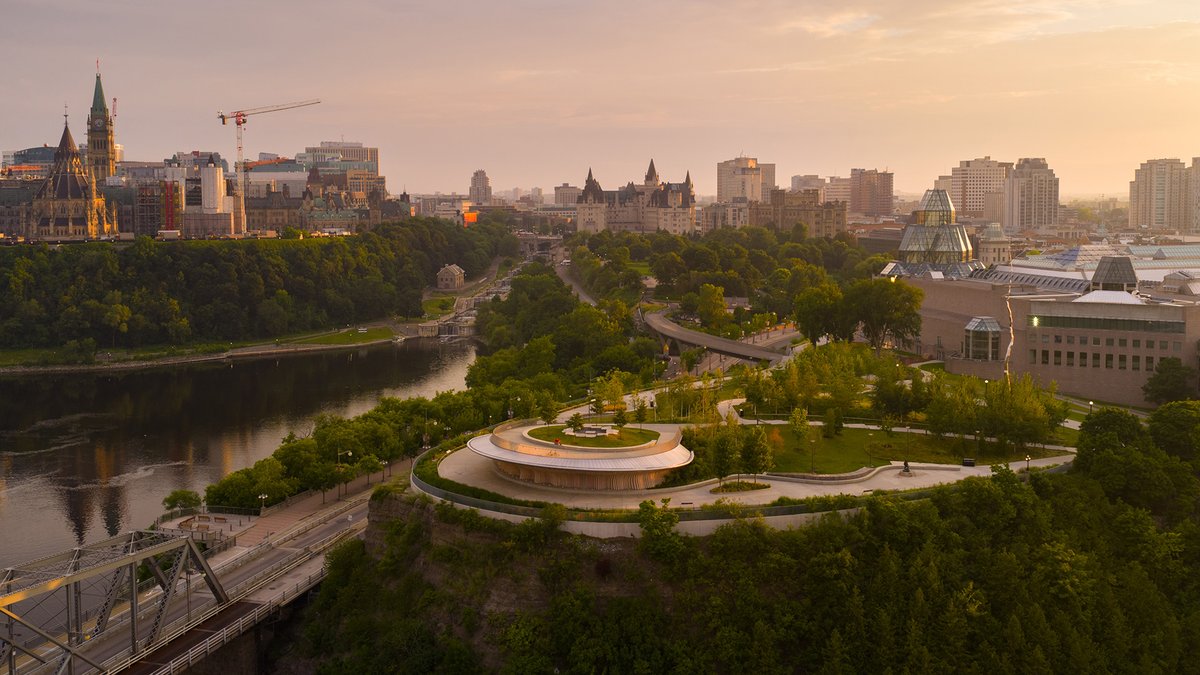
Ottawa’s Kìwekì Point is a project for the history books. The riverside park has been transformed by rethinking the placement of two monuments, creating a space that encourages visitors to engage with the region’s history.
The project began in 2017 when Janet Rosenberg & Studio, Patkau Architects, and ERA entered an international competition to revitalize Nepean Point. Their joint scheme aimed to provoke discovery of the park and the region’s history. However, the project’s agenda evolved as the designers engaged in conversations with the National Capital Commission and the Algonquin Anishinabeg communities of Pikwakanagan and Kitigan Zibi.
A New Perspective on History
The original statue featured a figure of Samuel de Champlain with an Indigenous guide at his feet. After protests led by Ovide Mercredi, the guide was moved to a separate space in Major’s Hill Park. The competition brief called for Champlain to remain atop his plinth, but the designers and communities decided to rethink the entire monument.
The result is an anti-monument that encourages visitors to become part of the space. Champlain has been brought down to ground level, emerging from a cluster of trees, while the Indigenous figure, now named Kichi Zïbï Innini or “Great River Man”, faces downstream towards the convergence of the Ottawa, Gatineau, and Rideau rivers.
Reconnecting the Park to the City
The reconfigured monument is just one part of a larger design that reconnects the park to the city. The Pìdàban Bridge restores a historical link to Ottawa, creating accessible pathways that join the bridge and the National Gallery of Canada to Whispering Point, a river lookout sheltered by a roof of aluminum panels and cedar ribs.
Related Post: Bathroom Space Solutions: Rethink Under-Sink Cabinet Designs
The design also incorporates an 18th-century garden feature called a “ha-ha” to ensure unimpeded views of the river. The irregular rhythm of the cedar ribs recalls the Canadian coastlines and creates an auditory and olfactory environment that channels sound and fragrance from the river.
Visitor Interaction and Sensory Experience
The remains of Champlain’s plinth have been rearranged, inviting visitors to become the monument themselves. People use the space for selfies and wedding proposals. The design encourages interaction, allowing visitors to appropriate the area for personal moments.
The Outlook, an overhang above Whispering Point, offers a unique viewing platform. Here, Champlain’s original plinth is deconstructed, with the explorer and his guide facing opposite directions. This layout maintains their relationship while recontextualizing their stories in a contemporary setting.
A Space for Reflection and Reconciliation
The project opens up an isolated promontory, reframing fraught relationships between the explorer and Indigenous figures. As Wayne Swanton of JRS notes, the monuments remain in dialogue, recontextualized in a contemporary way that carries their stories further while creating a renewed connection to the river. The project achieves a renewed connection to the river, and Ottawa is again turning toward its river, with the green space renamed Kìwekì Point, adopting a word that means “returning to one’s homeland” in Anishinaabemowin, marking a return that is also a rediscovery.
Related Stories
 DIY Project Fails
Ottawa’s Kìwekì Point Revitalized, Reimagining History and Space
 DIY Project Fails
Kingston co-living scheme opens with BREEAM Outstanding rating
 DIY Project Fails
London office building sets sustainability standard
 DIY Project Fails